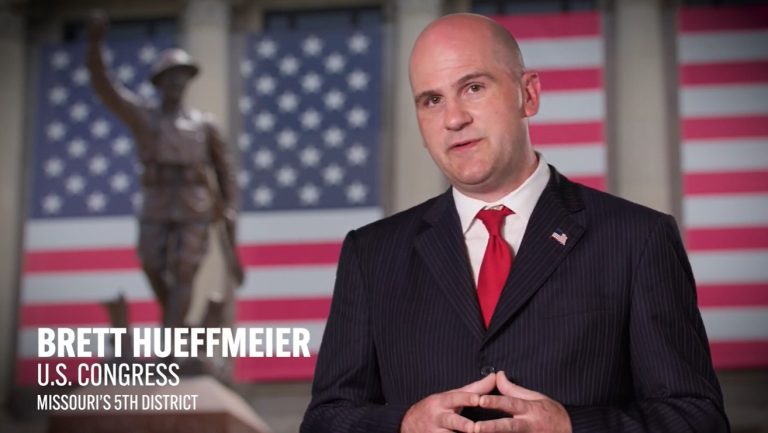
Brett Hueffmeier on Fox 4’s “4 the People”

Missouri Redistricting will impact who could be your congressman. Jonathan Ketz interviewed Brett Hueffmeier, Candidate for U.S. Congress, leading up to his bid to unseat Emanuel Cleaver. Cleaver first won the seat in 2004.
Ketz opened the interview with the question, “Why are you running in this congressional district?”
“This is where I live, that’s number one,” Hueffmeier said. He went on to point out that there has been too much political rancor, “but I don’t believe that the political divide is so great. I think that there’s a lot of political language that is used to polarize people, and I think it’s tearing this country apart. I want to be somebody who can bring people together.”
Hueffmeier demonstrated his legitimacy as the candidate who can represent the disparate concerns and opinions of the Fifth District, saying, “I may hold certain positions, but I have to represent people on the other side as well. And I think I have a pretty good way of speaking to people so that they understand different positions. I’m trying to get away from some of that more divisive language.”
The recent redistricting move supports democracy, Hueffmeier explained. “You’re forcing two other congressmen to move out to constituencies that they didn’t represent before. They have to go back and defend their records again. They have to prove that they are capable of getting the votes of those unrepresented constituents… and we’ve got to fight for all the citizens of this new district. That means that Emanuel Cleaver has to do that as well. I don’t think anyone should be sitting in a district where they just feel safe for reelection. A more diversified district, I don’t think, necessarily is a bad thing.” Other Republican congressmen will have to earn their votes from redistricted Democratic-leaning portions of the new map as well.
Hueffmeier also referenced his time working for Senator Ashcroft and Senator Bond, during which he learned the outsized impact that any mention in a local newspaper can have, as well as “any type of meeting you have with a constituency, or if you’re going out to events,” he said. “So I do a lot of that. I met with three different groups yesterday. We met with veterans, we went to Sedalia, we went to a healthcare center in Independence, and just sat down and talked to people. That has a major impact. Word of mouth has much more impact than people realize. The other way you get your name out there is, unfortunately, resources, money. And if you can get some national support, we believe that’s very important. We’ve done that.”
Ketz followed up, again referencing the new district map. “My question for you, Brett, is: are you running because of what Republicans did in September of 2025?” Hueffmeier’s answer was, “No. That did not even factor into my decision.” He went on to describe his relationship to rural Missouri. “I’m from a rural area, so I can go out and campaign in them more easily. But I’m determined to represent the city as well, and I would have done that independently if it stayed in the old district… You’ve got to support, economically, the district that you’re living in, and you’ve got to be enthralled in the constituency that you’re representing.”
The conversation then turned to national topics. “How do you feel about the war in Iran? Do you support what President Trump did?” Ketz asked.
“I do. And I would have supported it if it had been a Democratic president as well. I think that has been a brewing situation that’s been going on for probably the last twenty years, basically since we went into Iraq.
Remember, at the time, they defined an ‘axis of evil,’ and that was one of the three countries: North Korea, Iran, and Iraq. And at that time, they posed more of a risk to the United States for weapons of mass destruction than Iraq did. I’ve never quite understood why we focused so much on Iraq, when Iran posed such a potential. Now, we’ve tried for many years to deal with that through diplomacy. And I think we’ve had varying degrees of success with that. But at the end of the day, especially with this war going on that’s continuing in Isreal, we had to do something decisive. I don’t think there was a way to do it as a surprise, where it couldn’t have been articulated, probably better, to the American people beforehand. But I do think that it’s necessary to do it. And depending on how we define the word success in Iran, if it’s actually regime change, it may be harder than they were originally anticipating. I can see that being the case, but if it’s just to degrade the military capabilities of the government, then I think we’re doing a pretty good job of it now.”
On the topic of ICE and DHS raids, Hueffmeier responded by articulating the impossible situation. “Now, of course, we never want to see innocent Americans dying. And it’s very questionable when you see somebody being killed in something that looks like it’s just a protest. I don’t know all the facts, and I can’t speak to it necessarily in each instance, but what I can say is that we were planning to expand the ICE force, as far as the number of ICE agents they have in the United States, drastically, by thousands and thousands over the years. That was planned to be done over ten years, and I think they sped it up quite a bit. So when you’re bringing in that many people, and you’re trying to train them to do a very difficult job, trying to identify people that are here illegally and who have committed crimes in the past, when they don’t have proper identification to begin with, that’s very difficult. So they’ve been given an impossible job already, plus being trained to use lethal force in situations that may be dangerous; I think that’s very difficult. So the fact that we sped it up so much, I think, has created problems, and that’s something we’re going to run into. So I think they’ve got to take a step back, rethink the training certifications, whatever they’re doing with getting new ICE agents on the streets, and they’ve got to be better-trained for how they’re handling situations.”
The interview concluded with an in-depth report on the state of the redistricting process that was underway in the Missouri Supreme Court at the time of the interview.
More News
View all
This Week with Brett: Community Events, Candidate Forums, County Fairs, and Final Days Before the Primary Election
Welcome to the final Pre-Primary Election Day edition of Brett’s campaign update! As we enter the final days before the August 4 primary, Brett has continued traveling across Missouri’s Fifth District, meeting voters, listening to families, attending community events, and sharing his vision for a stronger Missouri. Over the past few weeks, Brett has had […]
The Outsider — And Proud to Represent You
He’s an outsider, and proud of that distinction. He’s here to bring your ideas to U.S. Congress, forming policy and positions by maintaining an open line of communication with the people of his district. Watch this video about why Brett’s the right Missourian to represent you!

Northeast News Highlights Brett Hueffmeier’s Experience, Leadership, and Serious Plans for Missouri’s Fifth District
A new candidate profile by Bryan Stalder of Northeast News in Kansas City highlights Brett Hueffmeier as a serious, prepared, and policy-focused candidate for Missouri’s Fifth Congressional District. The article describes Brett as “a Kansas City attorney and former academic dean” with executive leadership experience and past legislative experience working for U.S. Senators Kit Bond […]